Hesmerites
Humans with hard, rough skin, descended from the people of the city of Hesmar, in Cirda, whose essence changed and passed the change to their children.
Appearance and traits
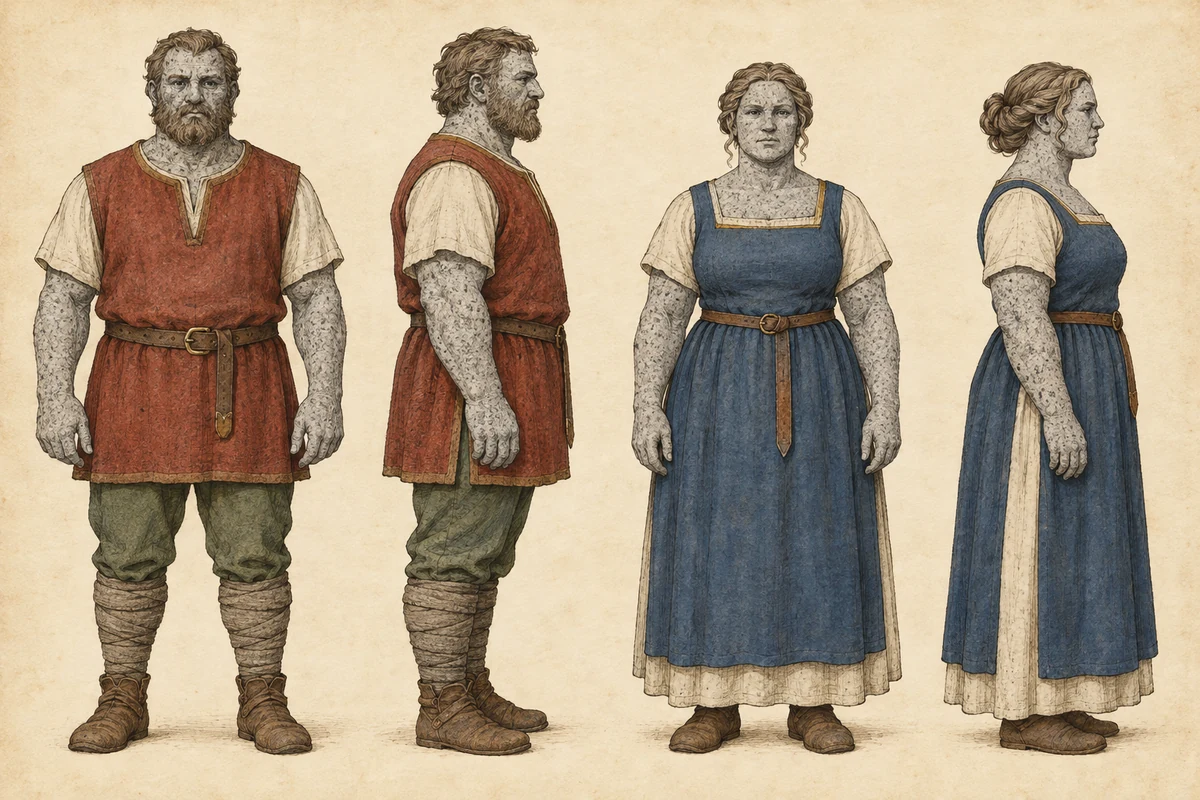
A Hesmerite’s skin has the grain and color of light granite: pale gray, speckled with dark flecks and crossed by fine veins. It covers the whole body, the face, lips and eyelids too. It looks like rock, but it is skin. It warms in the sun, feels a touch and bleeds when cut. It is only harder than an ordinary human’s, which is why cold and heat weigh on a Hesmerite less.
The body follows the skin. A Hesmerite is sturdier, broader and heavier than their neighbors, and stronger. In this there is no difference between men and women: the women are as broad and heavy as the men. The hair grows like any human’s, and on the bald the stone covers the scalp as well. They pay for it in agility: slow of foot and hand, and ill at ease where one must climb, dodge or pass unheard. The skin is no armor. A sword opens the flesh as it would anyone’s.
They age at the pace of other humans. Nor are they more or less gifted for magic: gifted children are born among Hesmerites as rarely as among everyone else. The gift is not inherited, and what Hesmerites inherit is something else: a change in the essence itself, which passes from parents to children.
When a Hesmerite and an ordinary human have a child, the trait thins. The child is born human, with a few marks on the skin as the only reminder. When both parents are Hesmerites, the child is one too.
Society and culture
Hesmerites have no lands or government of their own. They live scattered among humans, in Cirda and in Felgrum, and almost everyone knows one. Their looks draw the eye once and are forgotten. In most towns and cities no one treats them differently.
Hesmerite identity rests on origin more than on customs. Families remember where they come from, tell their children the stories of the city and speak of Hesmar as one speaks of a house one left. One story is told more often than the rest, that of the old man who caused it all. Children hear it as a tale and their elders as a doubt.
History
Hesmar was a small city of Cirda, raised by ordinary humans. The first generations noticed that their children’s skin came out more weathered. They blamed the sun of the savanna and the nearness of the Ambel Salt Flats, and no one took it for an ill. Over the generations the trait deepened. The skin hardened, and so did the body: the Hesmerites grew heavier, of another build.
No one knows what happened in Hesmar. Hesmerites tell versions without certainty, and the most widespread speaks of a neighbor who handled the essence in a way that reached the whole city. In children’s tales and legends he is called “the Old Man”. Those stories are popular lore and prove nothing: they may be true or not.
Fear that the change would keep growing emptied the city family by family. Some stayed many generations longer, and some lived the change as a pride of their own. In the end there were too few people left to hold up the walls, and the last of them died or left. The Hesmerites of today descend from those who left earlier.
Relations with other peoples
Dealings with ordinary humans are good in general, and mixed marriages are common.
Some reject them. Some call them abominations. Others hold that the change was a divine punishment for a supposed depravity that ran through the streets of Hesmar, and that the deeds of its people earned it. Those who say so are few.
The Vesper College of Mages looks on them with a different interest: it sees in them living proof that a being’s essence can change and stay changed. It sends expeditions to the Hesmar Ruins to seek the cause.
Related
- Humans
- Hesmar Ruins
- Cirda
- Ambel Salt Flats
- The Essence
- The Gift
- Vesper College of Mages